
Nosy or Nosey? The Great Debate
Nosy or Nosey is a linguistic conundrum that sparks debate among word lovers and everyday speakers alike.
While both spellings appear frequently in conversation, understanding the nuance between them can deepen our appreciation for language.
This article will explore the origins, usage, and implications of each term, shedding light on why getting it right matters in our increasingly interconnected world.
Origins and Etymology
The origins and etymology of “nosy” or “nosey” reveal a fascinating intersection of language and human behavior.
The History Behind “Nosey Vs Nosy.”
The terms “nosy” and “nosey” both trace their origins to the word “nose,” portraying a vivid image of someone intruding on matters that don’t concern them.
Emerging in the 19th century, both spellings highlight the lack of standardization in English at the time.
Here are some key points about their etymology:
- The words stem from “nose,” symbolizing intrusive curiosity.
- Historically, they described behavior marked by excessive inquisitiveness.
- Variations in spelling may reflect regional dialects and the fluid evolution of the English language.
British English vs American English
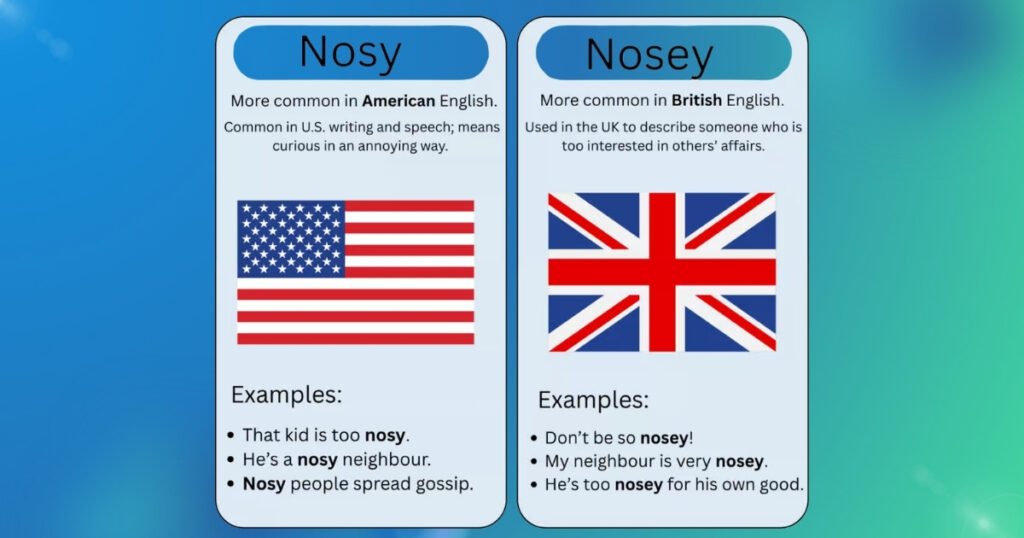
“Nosey” is often favored in the UK, and “nosy” reigns supreme across the pond in the United States.
This distinction highlights a fascinating aspect of language evolution and can also perplex writers and readers navigating between the two dialects.
| Country | Preferred Spelling | Common Usage in Media |
|---|---|---|
| United States | Nosy | News articles, informal writing |
| United Kingdom | Nosey | Magazines, books, formal publications |
Nosey or Nosy? Discovering Correct Spelling
Both terms describe someone who is overly curious or intrusive.
- In American English, “nosy” reigns as the correct spelling, endorsed by major dictionaries like Merriam-Webster and the American Heritage Dictionary.
- “Nosey” emerges as a British English variant, less frequent in formal contexts but still recognized in casual conversation.
Here’s a quick comparison between the two spellings:
| Word | Origin | Common Usage | Examples |
|---|---|---|---|
| Nosy | American English (Standard) | Widely accepted in formal and informal writing | “Stop being so nosy and mind your own business.” |
| Nosey | British English (Variant) | Less common, informal context | “My nosey neighbor always peeks over the fence.” |
Example:
Imagine you’re at a family gathering, and your aunt seems to know every detail about everyone’s lives, asking about your career, recent travels, and even your relationship status.
You would likely describe her as “nosy,” aligning with American English conventions. While “nosey” might be encountered occasionally, it’s generally viewed as less standard.
Read More: Shiney or Shiny: Which Spelling Is Correct? 10+ Best tips
Is it Nosy or Nosey?
Both refer to individuals who exhibit excessive curiosity about others’ private matters, often leading to intrusive behavior that can make people uncomfortable.
This type of inquisitiveness is often associated with negative connotations, implying a disregard for personal boundaries and privacy.
Definitions: Nosey vs. Nosy
The difference may seem trivial, but it reflects broader themes of language evolution.
Nosy: Definition and Usage
“Nosy” is a term primarily used in American English to describe someone who exhibits excessive curiosity or intrusive behavior, often with a negative connotation.
Individuals labeled as nosy tend to pry into private matters without consent, making their interest unwelcome.
Typical examples include:
- “He’s so nosy; he always wants to know what I’m up to.”
- “Stop being nosy; that’s not your concern.”
Nosey: Alternative Spelling
“Nosey” serves as an alternative spelling, particularly favored in British English. Some people perceive it as carrying a softer, more playful tone, making it suitable for casual or informal contexts.
For example:
- Why are you being so nosey about my plans?”
- “That’s just Jane being nosey again.”
Context and Connotation
Context and connotation play crucial roles in how words are perceived. Nosey or Nosy meaning is described based on the context:
- For American readers, “nosy” is more recognizable and widely accepted.
- British readers might resonate better with the quirky familiarity of “nosey.”
Read More: Tying or Tieing: Learn the Correct Form
Conclusion
Nosy or Nosey emphasizes the subtle differences that can arise in language use, prompting us to reflect on the many ways we convey curiosity and concern.
This exploration reveals that while the terms may be interchangeable in some contexts, their regional preferences can bring about interesting discussions.
FAQs
Is Nosy a Rude Word?
Yes, “nosy” is typically viewed as a mildly negative term. It describes someone who intrudes into others’ affairs or shows excessive curiosity.
How to Spell Nosy or Nosey?
Both are acceptable spellings, but “nosy” is the more common and preferred form in modern English.